Vegetarian Pad Thai (No Fish Sauce)
The authentic taste of Bangkok, but 100% plant-based. Learn the secret of the irresistible tamarind sauce and perfectly chewy, non-sticky noodles.
Jump to Recipe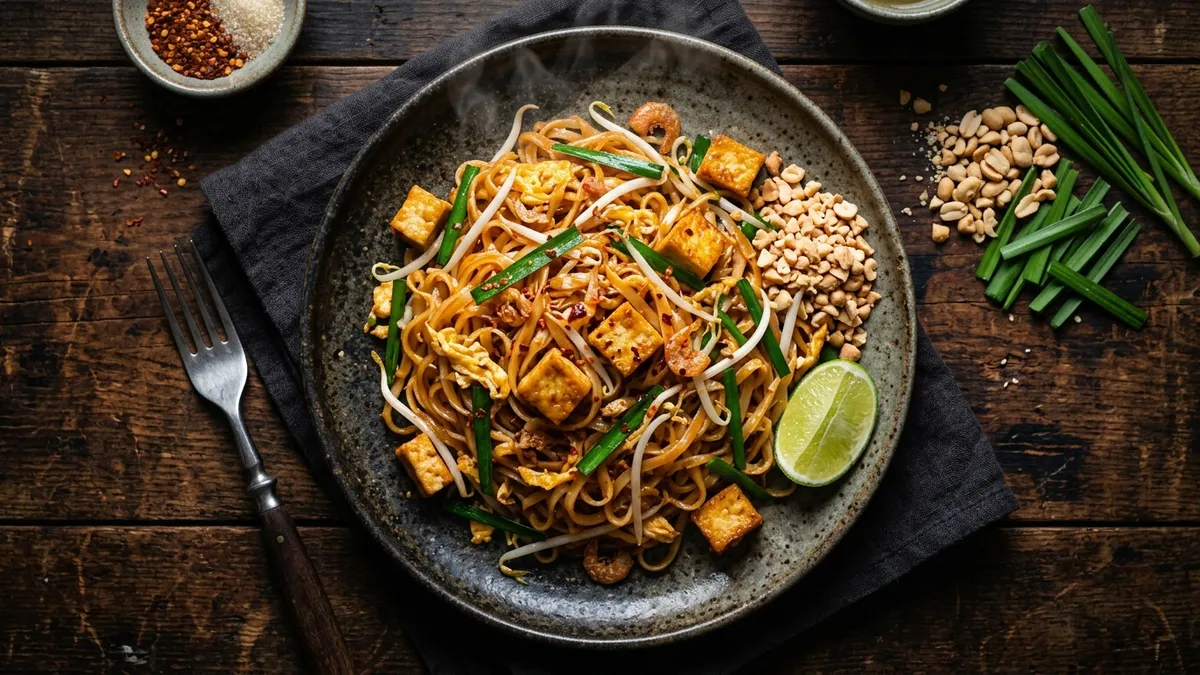
🧂Ingredientsfor 2 persons
- Rice noodles (Sen Lek, 3-5mm)150g
- Thai tamarind paste (Lobo or Cock Brand)↳ Substitute: See our tamarind replacement guide3 tbsp
- Palm sugar (finely chopped)3 tbsp
- Vegan fish sauce (Yakso or Nature's Charm)↳ Substitute: Or 2 tbsp soy sauce + 1 tbsp mushroom stir-fry sauce3 tbsp
- Shallot (finely diced)2 pieces
- Garlic (finely chopped)3 cloves
- Chai Po Wan (sweet pickled radish)2 tbsp
- Chinese chives or scallionsHandful (cut into 4cm pieces)
- Bean sprouts2 large handfuls
- Extra firm tofu200g
- Roasted peanuts (roughly crushed)3 tbsp
- Lime (in wedges, for serving)1 piece
Listen, we need to have a serious talk about what you’ve been calling Pad Thai. Pad Thai is arguably the most infamous dish for home cooks to tackle. Far too often, you end up staring at a sad, mushy, sweet-and-sour ball of dough that somehow tastes vaguely of ketchup. That happens because westernized recipes almost universally make two fatal errors: they boil the noodles, and they throw in a random assortment of watery stir-fry vegetables.
In Thailand, they understand exactly how to build this masterpiece. A genuinely good Pad Thai is the ultimate high-wire balancing act between sweet, sour, and salty, built around irresistibly chewy, perfectly separated noodles. And the beautiful part? The authentic, salty umami kick of traditional fish sauce—which you can read more about in our fish sauce substitute guide—is surprisingly simple to recreate with 100% plant-based ingredients.
With this recipe, you are going to make Pad Thai exactly as you would find it sizzling on the streets of Bangkok, completely free of animal products. Get your wok ready.
The Noodle Science: Why Your Pad Thai Stuck Together (And How We Fix It)
If your noodles have historically morphed into a sticky, gelatinous clump the second they hit the pan, you are almost certainly boiling them. Stop doing that. Immediately.
NEVER BOIL YOUR NOODLES. When you boil dried rice noodles in hot water, the starches expand rapidly and gorge themselves on neutral, flavorless water. By the time they hit the screaming hot wok, their structural integrity is compromised. They break apart, turn to mush, and ruin your dinner.
The Solution: You need to soak your dried rice noodles (you want the medium width ones, known as sen lek) for 45 to 60 minutes in cold or room temperature water. What you’re looking for is flexibility without fragility. They should hang limply over your finger without snapping, but still feel quite firm—very al dente—and remain opaque white.
Why do we do this? Because in the wok, these thirsty, un-cooked noodles will drink up your incredibly flavorful, caramelized Pad Thai sauce in order to finish cooking. The flavor gets literally trapped inside the noodle matrix, and they retain a spectacular chewy bite.
The Holy Trinity: Building the Perfect Pad Thai Sauce
The soul of Pad Thai has absolutely nothing to do with sweet chili sauce or ketchup. Please, put the ketchup away. The magic happens through the holy trinity of Thai cooking: sour, sweet, and salty, balanced in perfectly equal volumes.
- Sour: 3 tablespoons of Thai tamarind paste. Pay close attention here: you need the brown pulp from a jar (like Lobo or Cock Brand). Do NOT use Indian tamarind concentrate, which is pitch black, thick as tar, and about three times as strong. It will overpower everything. (Check our tamarind substitute guide for more details).
- Sweet: 3 tablespoons of finely chopped palm sugar. It provides a deep, caramel-like sweetness that white sugar just can’t match.
- Salty (Umami): 3 tablespoons of vegan fish sauce (Yakso or Nature’s Charm are great).
Crucial rule regarding lime juice: Never, ever add lime juice directly into your wok sauce! High heat destroys the fresh, volatile terpenes in the citrus and turns the juice bitter. Lime is purely a finishing move—you squeeze it over your plate right before you eat.
The Missing Puzzle Piece: Chai Po Wan
Almost every westernized recipe completely ignores the ingredient that gives authentic Pad Thai its complex, addictive, “I can’t stop eating this” quality: Chai Po Wan (sweet pickled radish).
You can find this tightly packed in small vacuum bags at your local Asian supermarket. It delivers crunchy, sweet-and-salty umami explosions in every single bite. Do not skip this! It elevates the dish from “pretty good” to “restaurant quality.” Alongside this, we use shallots (which are sweeter and less pungent than regular yellow onions) and Chinese chives (though scallions work in a pinch).
Substitutes with Exact Ratios
Don’t have a specific ingredient? Here are the exact conversion ratios to save your dinner:
1. Vegan Fish Sauce Substitute If you can’t find commercial vegan fish sauce, you can build a powerful umami base yourself. Ratio: Substitute 3 tbsp vegan fish sauce with 2 tbsp light soy sauce + 1 tbsp vegetarian mushroom stir-fry sauce. This gives you both the salinity of the soy and the deep, earthy body of the mushroom sauce.
2. Palm Sugar Substitute Palm sugar has a distinct caramel/butterscotch note. Ratio: Substitute 3 tbsp palm sugar with 3 tbsp light brown sugar + a tiny splash of maple syrup.
3. Chai Po Wan (Pickled Radish) Substitute Hard to find, but you need that crunchy, salty-sweet pop. Ratio: Substitute 2 tbsp Chai Po Wan with 2 tbsp finely diced daikon radish soaked in 1 tsp soy sauce and 1/2 tsp sugar for 10 minutes.
Substitute Comparison Table
| Original Ingredient | Best Substitute | Ratio | Flavor Difference |
|---|---|---|---|
| Vegan Fish Sauce (3 tbsp) | Light soy sauce + Mushroom sauce | 2 tbsp soy + 1 tbsp mushroom | Slightly earthier, less funky but great umami |
| Palm Sugar (3 tbsp) | Light brown sugar | 1:1 substitution | Slightly less complex caramel notes |
| Thai Tamarind Paste (3 tbsp) | Rice vinegar + Lime + Brown sugar | 1 tbsp vinegar + 1 tbsp lime + 1 tbsp sugar | Lacks the fruity depth of tamarind |
| Chai Po Wan (2 tbsp) | Marinated fresh daikon | 1:1 substitution | Less fermented funk, but provides the needed crunch |
The Method: How to Wok Like a Pro
Step 1: Preparation (Mise en place is everything)
Pad Thai is cooked over brutally high heat and is entirely finished in about 3 minutes. If you are chopping garlic while the oil is smoking, you have already lost. Have every single ingredient chopped, measured, and sitting in small bowls right next to your stove.
Cut your extra firm tofu into small batons. (Pro tip: if you want them to hold up perfectly in the aggressive wok environment without crumbling, throw them in the air fryer first following our crispy air fryer tofu method).
Step 2: Caramelizing the Sauce
Place your finely chopped palm sugar with one teaspoon of water into a small saucepan over medium-high heat. Let it bubble furiously until it melts and caramelizes into a deep golden brown (this takes about 2 minutes).
Immediately deglaze the pan with your tamarind paste, vegan fish sauce (or your soy/mushroom mix), and 2 more tablespoons of water. Stir constantly until the caramelized sugar is completely dissolved into the liquid. Set this glorious, sticky sauce aside.
Step 3: The Wok Action
- Heat a large wok (preferably carbon steel or cast iron) over high heat until it literally starts to smoke.
- Pour in 2 tablespoons of neutral oil.
- Throw in the tofu batons and fry until they achieve a golden-brown crust.
- Toss in the diced shallot, minced garlic, and the Chai Po Wan (pickled radish). Stir-fry aggressively for 20-30 seconds until wildly fragrant. Keep it moving; do not let that garlic burn.
- Grab your drained, raw (but soaked!) rice noodles, throw them into the wok, and stir-fry for exactly 1 minute on high heat.
- Immediately pour your warm, caramelized Pad Thai sauce straight over the noodles. Keep tossing them constantly with a pair of tongs or two spatulas. Watch the magic happen: within 60 seconds, the noodles will drink up all the sauce, softening perfectly while retaining their chew.
- Shove everything to one side of the wok (add a tiny drop of oil to the empty side if it looks dry). If you eat eggs, this is where you’d crack two in and scramble them before folding them through. Since we’re keeping this vegan, we skip this and keep moving!
- TURN OFF THE HEAT.
- Toss in your Chinese chives (or scallions), half of your fresh bean sprouts, and half of your crushed peanuts. Give everything one final, vigorous toss so the residual heat just barely wilts the greens.
Step 4: Plating Like Bangkok
Get it out of the hot wok immediately so it doesn’t overcook. Serve it on a large plate. Pile the remaining raw bean sprouts right next to the noodles—this raw/cooked contrast is essential. Scatter the rest of your crushed peanuts over the top, place a wedge of fresh lime on the side, and offer some dried chili flakes for anyone who wants to sweat a little.
Common Mistakes (Don’t Do This)
- Boiling the noodles first: We covered this. They will turn into a depressing paste in the wok.
- Adding watery vegetables: Bell peppers, zucchini, and mushrooms leak massive amounts of water when cooked. A wet Pad Thai is a sad Pad Thai. Stick to the program.
- Crowding the wok: If you try to cook for four people in one wok, the temperature plummets. You end up steaming the noodles instead of frying them. Never cook more than 2 portions at a time!
Frequently Asked Questions (FAQ)
Can I just use a regular yellow onion instead of shallots?
You can, but you shouldn’t if you want the real deal. Shallots are sweeter, milder, and far more aromatic. Thai cuisine rarely uses those large, pungent yellow onions for these incredibly fast, high-heat stir-fries because they don’t break down fast enough.
Where exactly do I buy Thai tamarind paste?
Head to your local Asian supermarket (like Amazing Oriental or a Toko). You are looking for glass or plastic jars filled with a brownish pulp from brands like Lobo or Cock Brand. Do not buy the tiny, black, sticky jars from Indian brands (like TRS)—they are hyper-concentrated and will ruin the flavor balance.
I added the sauce, but my noodles are still hard. What did I do wrong?
Two possibilities: either you didn’t soak them long enough in the beginning, or your heat was too low, causing the water in the sauce to evaporate before the noodles had a chance to absorb it. The fix? Toss in a tiny splash of hot water or vegetable broth and keep stir-frying until they reach the perfect chewy texture.
Can I meal-prep Pad Thai and make it in advance?
No. Reheated Pad Thai is not a thing in the culinary world. It devolves into a dense, sticky block of sadness in the fridge. What you can do is prep like a restaurant: make the sauce days in advance, and soak your noodles ahead of time (store them drained in the fridge). When your friends come over, the actual cooking process will literally take you 3 minutes. Fresh and perfect.